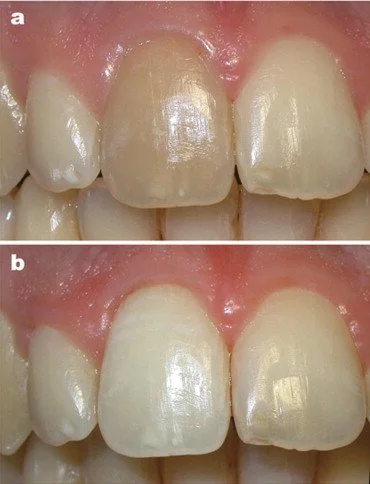
Internal Bleaching for Discolored Teeth in Oakton, VA
A tooth can sometimes darken following trauma, pulpal injury, or root canal treatment. Unlike traditional whitening, which works from the outside surface of the tooth, internal bleaching places whitening material inside a previously root canal-treated tooth to improve discoloration from within.
Not every discolored tooth is a candidate for internal bleaching. The tooth should first be evaluated to determine the cause of discoloration and confirm that the previous root canal treatment and surrounding tissues are healthy.
-
A tooth can darken after trauma, loss of vitality, or root canal treatment. Changes inside the tooth—such as breakdown products from blood or pulpal tissue—can become incorporated into the tooth structure and cause discoloration from within.
In some cases, materials used during previous dental or root canal treatment may also contribute to a darker appearance.
Because the source of discoloration is inside the tooth, traditional whitening treatments applied to the outside surface may have limited effect.
-
Internal bleaching, sometimes called non-vital bleaching, is a whitening technique used for certain discolored teeth that have already received root canal treatment.
Instead of applying whitening material only to the outside of the tooth, a bleaching material is carefully placed inside the tooth. This allows the discoloration to be treated from within while preserving the natural tooth structure.
The goal is to improve the color of the affected tooth so that it blends more naturally with the surrounding teeth.
-
Internal bleaching may be an option when a single root canal-treated tooth has become noticeably darker than the surrounding teeth.
Before treatment, the tooth should be evaluated to determine the cause of the discoloration and confirm that the existing root canal treatment and surrounding tissues are healthy.
Good candidates generally have:
A previously root canal-treated tooth
Discoloration originating from within the tooth
Adequate remaining tooth structure
No active infection or unresolved endodontic disease
A tooth that can be predictably restored after bleaching
Internal bleaching may not be appropriate for every type of discoloration, and teeth with extensive restorations, fractures, or other structural concerns may require a different approach.
-
The tooth is first evaluated clinically and radiographically to confirm that internal bleaching is appropriate.
A small opening is then made through the existing restoration to access the internal portion of the tooth. The root canal filling is protected with a barrier, and bleaching material is placed inside the crown of the tooth.
The tooth is temporarily sealed while the bleaching material works. At a follow-up visit, the color is evaluated and the process may be repeated until an appropriate result is achieved.
Once the desired shade is reached, the bleaching material is removed and the access opening is permanently restored.
-
The number of visits depends on the degree and cause of discoloration and how the tooth responds to treatment.
Many teeth require more than one bleaching cycle, with the color evaluated between visits. Some discoloration improves quickly, while darker or longstanding discoloration may require additional treatment.
The final shade cannot be guaranteed, and some teeth may gradually darken again over time. Dr. Safi will monitor the color throughout treatment and discuss when an appropriate result has been reached.
At Endodontic Studio | Oakton, Dr. Abasin Safi provides internal bleaching for appropriately selected root canal-treated teeth that have developed discoloration.
Before treatment, the tooth is carefully evaluated to confirm that the previous root canal treatment is healthy and that internal bleaching is an appropriate option.
Our goal is to improve the appearance of the discolored tooth conservatively while preserving as much natural tooth structure as possible.
Reviewed by Abasin Safi, DMD
Endodontist, Endodontic Studio | Oakton